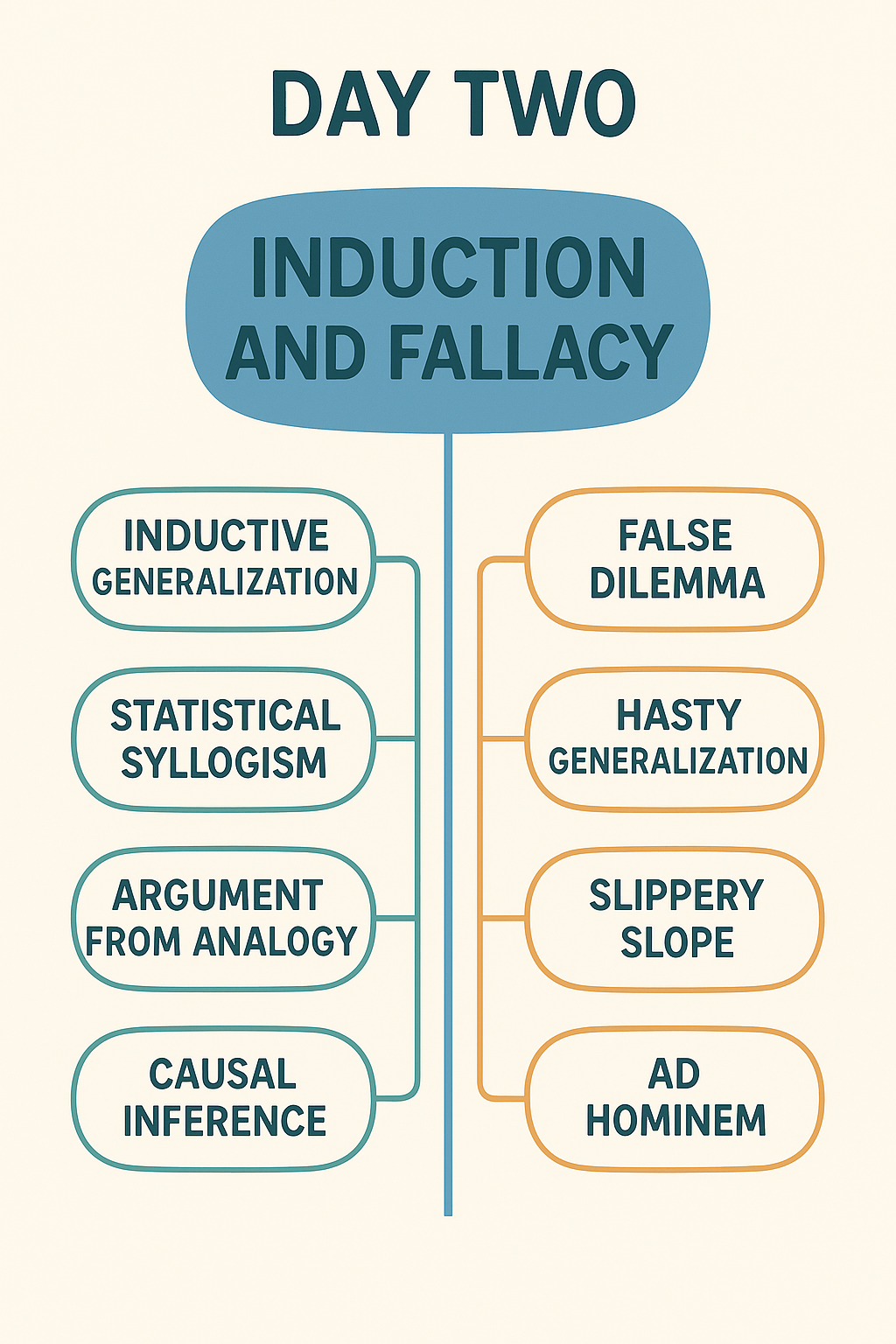
Day 2: Arguments and Fallacies
Course Objectives
- Analyze the structure of arguments, identifying premises and conclusions
- Distinguish between valid and invalid arguments
- Understand the difference between deductive and inductive reasoning
- Identify common logical fallacies
- Apply critical thinking to evaluate arguments
Basic Structure of Arguments
A complete argument typically includes the following parts:
- Premises: Statements used to support the conclusion, there may be one or more
- Inference process: The thought process from premises to conclusion
- Conclusion: The statement that the argument attempts to prove or support
Types of Arguments
Based on different inference methods, arguments can be divided into two main categories:
- Deductive arguments: If the premises are true, then the conclusion must be true
- Inductive arguments: If the premises are true, the conclusion may be true, but not necessarily
Valid Arguments
A valid argument is one where if all premises are true, then the conclusion must be true.
Example:
All humans are mortal. (Premise)
Socrates is human. (Premise)
Therefore, Socrates is mortal. (Conclusion)
Invalid Arguments
An invalid argument is one where even if all premises are true, the conclusion may still be false.
Example:
If it rains, the ground will be wet. (Premise)
The ground is wet. (Premise)
Therefore, it has rained. (Conclusion)
Sound Arguments
A sound argument is one that is both valid and has true premises.
Example:
All mammals have lungs. (Premise, true)
Whales are mammals. (Premise, true)
Therefore, whales have lungs. (Conclusion, true)
Deductive Reasoning
Deductive reasoning is the process of reasoning from general principles to specific instances.
Characteristics:
- From general to specific
- High certainty of conclusion
- Does not add new information, only reveals information implicit in the premises
Inductive Reasoning
Inductive reasoning is the process of reasoning from specific instances to general principles.
Characteristics:
- From specific to general
- Lower certainty of conclusion
- Adds new information, beyond the scope of the premises
Common Logical Fallacies
Logical fallacies are errors in the reasoning process that make arguments invalid or unsound.
- Ad Hominem Fallacy
- Appeal to Authority Fallacy
- Straw Man Fallacy
- Slippery Slope Fallacy
- Appeal to Emotion Fallacy
Ad Hominem Fallacy
The Ad Hominem fallacy involves attacking the person making the argument, rather than the argument itself.
Example:
Xiao Ming says we should exercise more, but he rarely exercises himself, so his advice is not worth listening to.
Appeal to Authority Fallacy
The Appeal to Authority fallacy is assuming something is true simply because an authority figure said it.
Example:
Famous actor Xiao Hua says this weight loss pill is effective, so it must be effective.
Straw Man Fallacy
The Straw Man fallacy involves misrepresenting someone's argument to make it easier to attack.
Example:
Xiao Li: I think the school should provide more sports activity options.
Xiao Zhang: How can you think that studying is not important? We come to school to study, not to play.
Slippery Slope Fallacy
The Slippery Slope fallacy assumes that taking a certain action will lead to a series of uncontrollable consequences, ultimately resulting in a disastrous outcome.
Example:
If we allow students to use phones in class, they will play with their phones all day, not study, and ultimately fail academically.
Critical Thinking
Critical thinking is a rational, reflective way of thinking that helps us make more informed judgments and decisions.
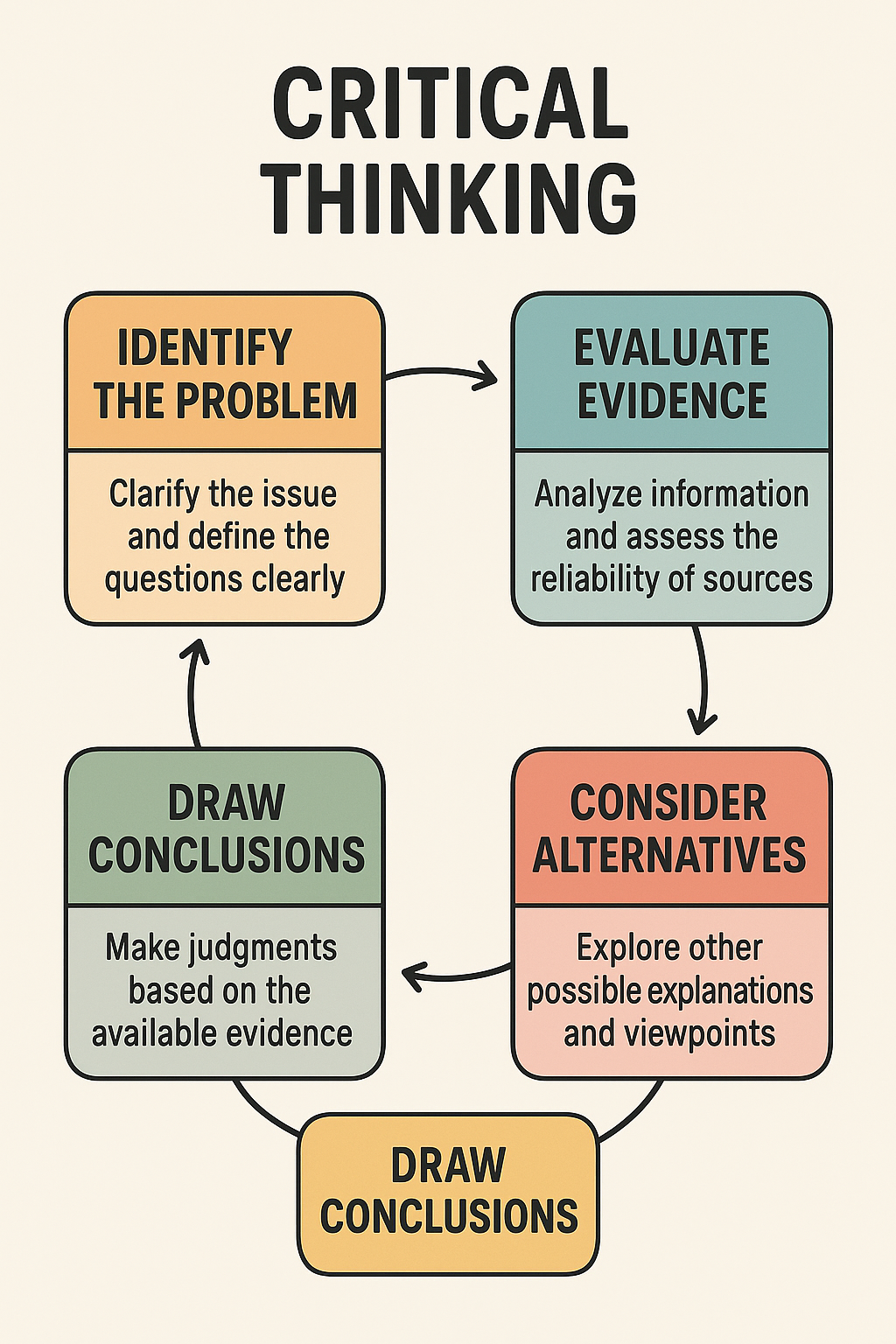
Basic Steps of Critical Thinking
- Identify the problem: Clarify the problem you want to solve or the argument you want to evaluate
- Gather information: Look for relevant facts, data, and perspectives
- Evaluate evidence: Check the reliability and relevance of the evidence
- Consider alternative explanations: Think about other possible explanations or perspectives
- Form a conclusion: Draw a conclusion based on evidence and reasoning
Course Summary
In today's course, we learned:
- The structure and types of arguments, including premises, inference process, and conclusion
- The distinction between valid and invalid arguments, and the concept of sound arguments
- The characteristics and differences between deductive and inductive reasoning
- Common logical fallacies, including ad hominem, appeal to authority, straw man, slippery slope, and appeal to emotion
- The basic steps and attitudes of critical thinking
Mind Map Overview