Day 5: Inductive Reasoning and Critical Thinking
Understand the features of inductive reasoning, learn the principles of analogical and causal reasoning, and apply critical thinking skills.
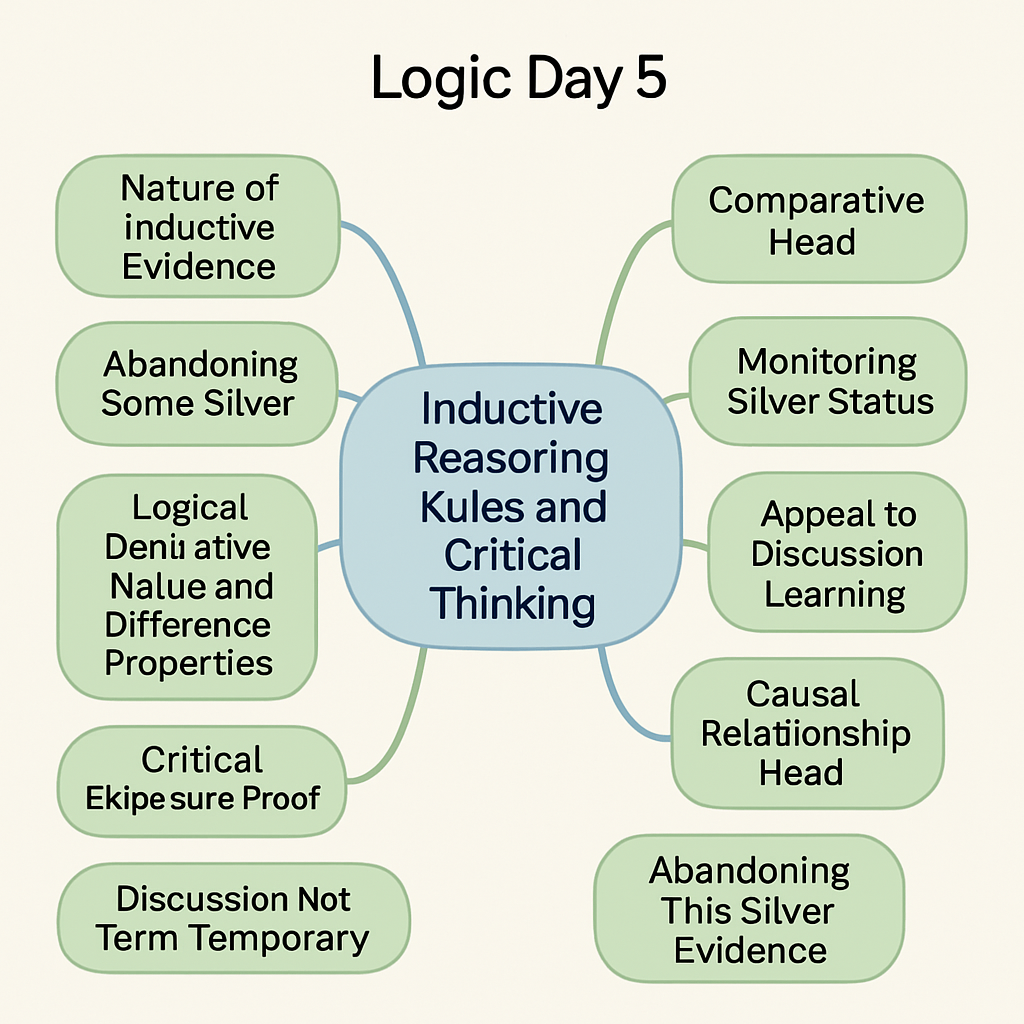
Mind map of inductive reasoning and critical thinking
Course Objectives
This lesson introduces the basic ideas of inductive reasoning. Students will learn analogical and causal reasoning and practice critical thinking.
After completing this lesson, students will be able to:
- Understand the features and uses of inductive reasoning
- Analyze the structure of analogical arguments and evaluate their strength
- Understand causal reasoning and Mill's methods
- Apply critical thinking skills to evaluate arguments and information
- Understand the relationship between the scientific method and hypotheses
Inductive Reasoning Basics
Inductive reasoning moves from particular cases to general principles. Even with true premises, the conclusion is only probable, not certain.
Characteristics
- From specific to general
- Probability: the conclusion may still be false
- Uncertainty: lower degree of certainty
- Adds new information beyond the premises
Example
Every crow observed is black. (Particular case)
Therefore, all crows are black. (General principle)
This conclusion is likely but not certain, because we cannot observe every crow.
Strength of Inductive Arguments
The strength of an inductive argument depends on:
- Number of examples: more examples give stronger support
- Representativeness of the sample
- Lack of counterexamples
- Narrowness of the conclusion
Argument by Analogy
Analogical reasoning infers that because two things share some properties, they may share others as well.
Structure
An analogical argument typically has this form:
- A has properties P, Q, R, S...
- B has properties P, Q, R...
- Therefore, B may also have property S
Example
Earth has an atmosphere, water, suitable temperatures, and life.
Mars has an atmosphere (thin), water (as ice), and fairly suitable temperatures.
Therefore, Mars might also have life.
Evaluating Strength
The strength of an analogical argument depends on:
- Number of similarities
- Relevance of similarities
- Number of differences
- Relevance of differences
- Scope of the conclusion
Causal Reasoning
Causal reasoning studies whether one event (the cause) leads to another event (the effect).
Basic Concepts
- Cause: the event or condition that produces an effect
- Effect: the event or state produced
- Necessary condition: without it the effect cannot occur
- Sufficient condition: if it occurs, the effect must occur
Common Fallacies
- Post hoc: assuming A caused B simply because B follows A
- Correlation fallacy: assuming correlation implies causation
- Ignoring common causes
- Ignoring complex causes
Mill's Methods
John Stuart Mill proposed several methods for discovering causal relationships.
Method of Agreement
If different cases of an effect share a common factor, that factor may be the cause.
Case1: A,B,C occur and X happens.
Case2: A,D,E occur and X happens.
Case3: A,F,G occur and X happens.
Therefore A may be the cause of X.
Method of Difference
If two situations differ in only one factor and the outcomes differ, that factor may explain the difference.
Case1: A,B,C occur and X happens.
Case2: B,C occur (without A) and X does not happen.
Therefore A may be the cause of X.
Method of Concomitant Variation
If changes in one factor accompany changes in the effect, that factor may be a cause.
Case1: A level 1, X level 10
Case2: A level 2, X level 20
Case3: A level 3, X level 30
Therefore A may be the cause of X
Method of Residues
If part of the effect is explained by known causes, the remaining part may be due to other factors.
Effect X has parts X1 and X2.
A is known to cause X1.
Therefore other factors (like B) may cause X2.
Joint Method
Combine the above methods to determine causation.
Critical Thinking
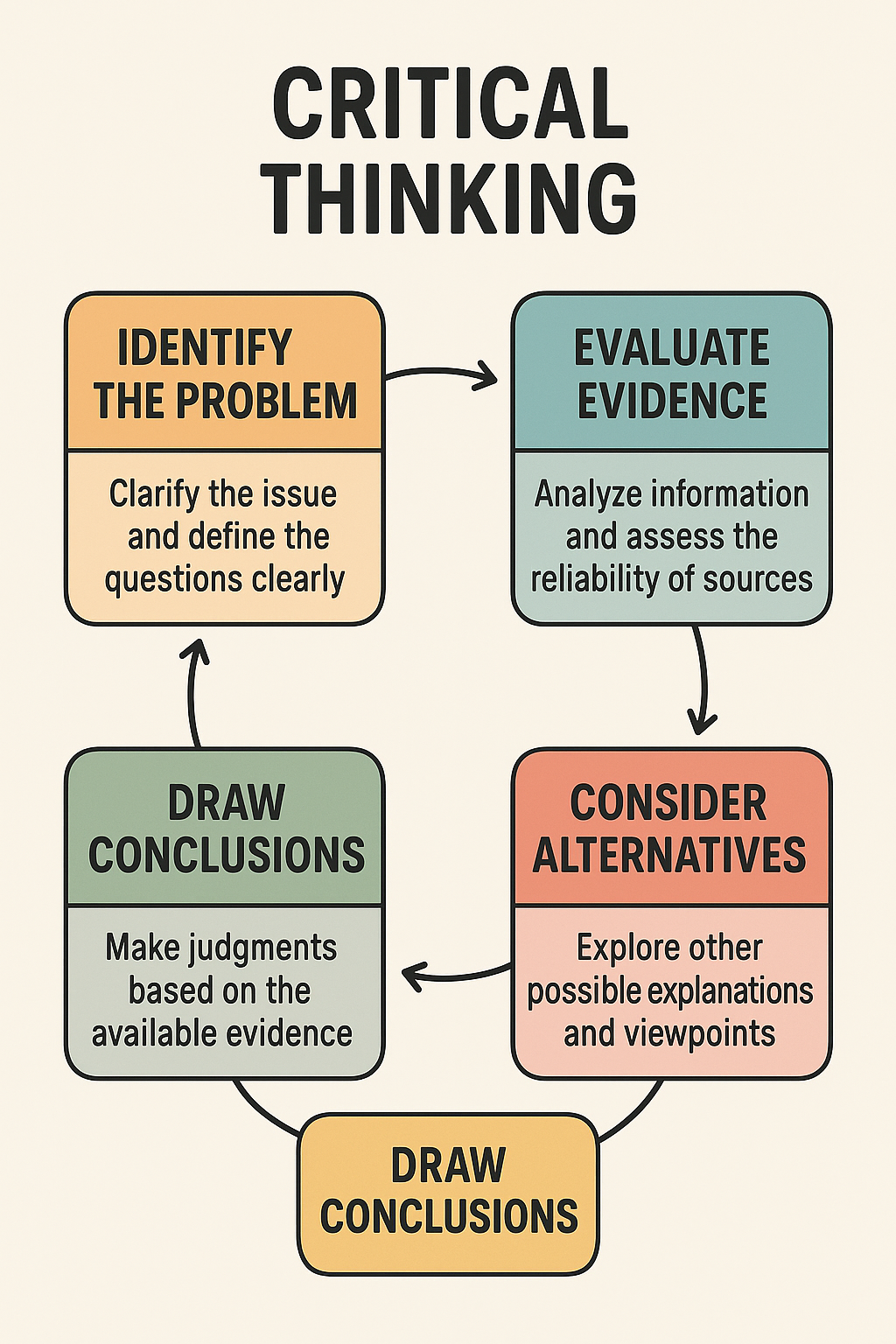
Critical thinking is a rational and reflective way of reasoning that helps us make better judgments and decisions.
Basic Steps
- Identify the problem
- Gather information
- Evaluate evidence
- Consider alternatives
- Draw a conclusion
Attitudes
- Openness
- Curiosity
- Skepticism
- Humility
- Systematic thinking
Applications
Critical thinking can be used in many situations, including:
- Evaluating news and media reports
- Analyzing political statements and policies
- Assessing scientific research and discoveries
- Solving everyday problems
- Making important personal and professional decisions
Scientific Method and Hypotheses
The scientific method is a systematic approach to acquiring knowledge, combining deductive and inductive reasoning.
Steps of the Scientific Method
- Observation: gather data
- Question: formulate a question
- Hypothesis: propose a possible explanation
- Prediction: what should be observed if the hypothesis is true
- Testing: experiment or further observation
- Analysis: examine the results
- Conclusion: support or reject the hypothesis
- Replication: repeat the process to confirm
Characteristics of a Good Hypothesis
A good scientific hypothesis should:
- Be falsifiable
- Explain observations
- Be simple
- Be consistent with known facts
- Be testable
Logic in the Scientific Method
The scientific method combines deductive and inductive reasoning:
- Deductive reasoning: deriving predictions from a hypothesis
- Inductive reasoning: forming general principles from observations
Course Summary
Today we learned:
- The features and uses of inductive reasoning
- The structure and evaluation of analogical arguments
- The principles of causal reasoning and common fallacies
- Mill's five methods: agreement, difference, concomitant variation, residues, and joint method
- The basic steps and attitudes of critical thinking
- The steps of the scientific method and the nature of hypotheses
These skills will help you better understand inductive reasoning, improve critical thinking, and appreciate the role of the scientific method.