Day 2: Arguments and Fallacies
Understand the difference between valid and invalid arguments, learn the features of deductive and inductive reasoning, and identify common logical fallacies.
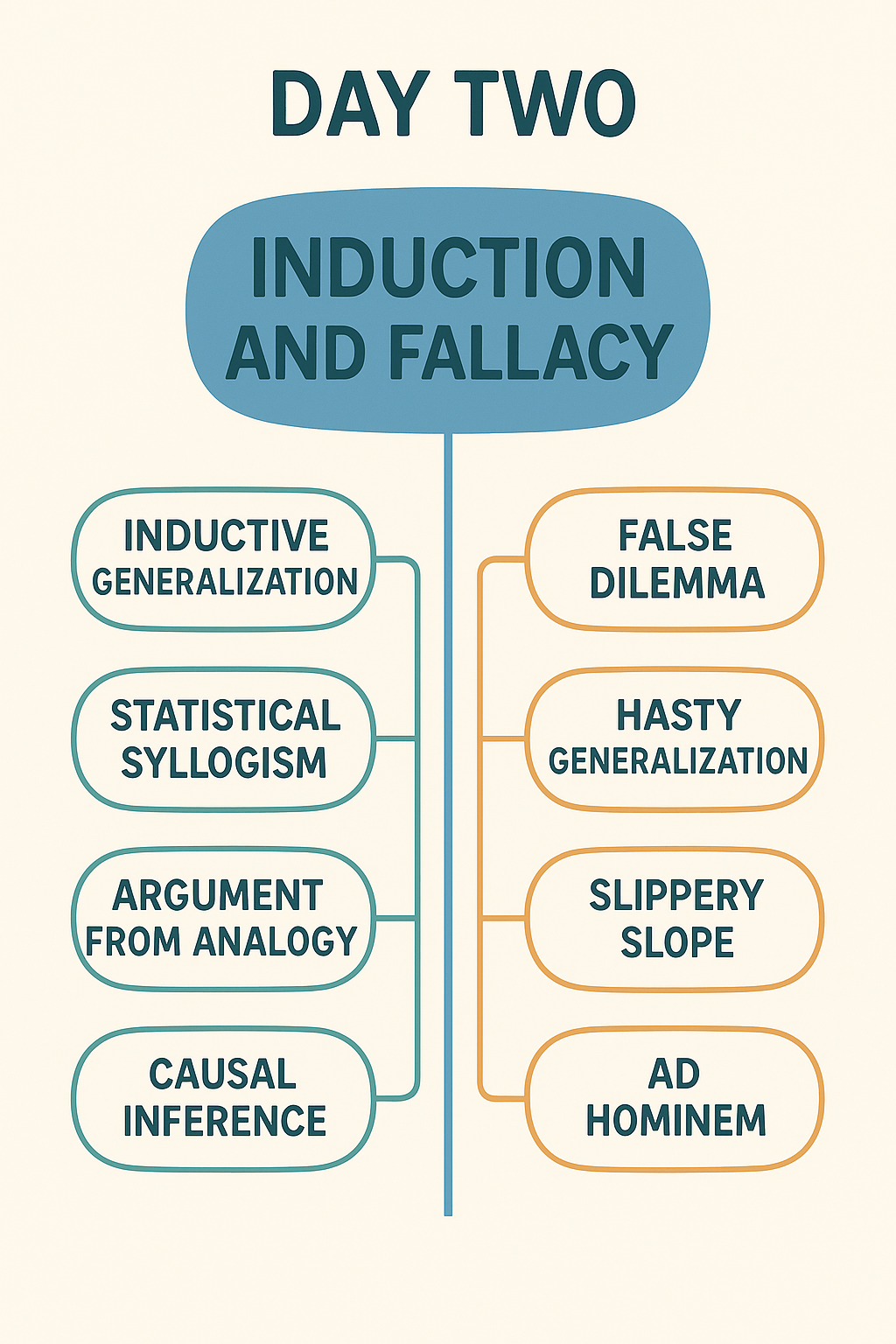
Mind map of arguments and fallacies
Course Objectives
This lesson helps students understand the structure and types of arguments, distinguish valid from invalid reasoning, recognize deductive and inductive reasoning, and identify common logical fallacies. These skills build a foundation for critical thinking.
After completing this lesson, students will be able to:
- Analyze the structure of arguments, identifying premises and conclusions
- Distinguish between valid and invalid arguments
- Understand the difference between deductive and inductive reasoning
- Recognize common logical fallacies
- Apply critical thinking to evaluate arguments
Argument Structure and Types
An argument consists of a set of statements. Some statements (premises) support another statement (the conclusion). Yesterday we learned how to identify premises and conclusions. Today we'll look deeper into how arguments are organized.
Basic Structure
A complete argument usually contains the following parts:
- Premise: Statements used to support the conclusion, there may be one or more
- Inference process: The thought process from premises to conclusion
- Conclusion: The statement that the argument attempts to prove or support
Types of Arguments
Depending on the form of reasoning, arguments can be divided into two main types:
- Deductive Argument: If the premises are true, then the conclusion must be true
- Inductive Argument: If the premises are true, the conclusion may be true, but not necessarily
Valid and Invalid Arguments
The validity of an argument is an important standard for evaluating its quality.
Valid Argument
A valid argument is one in which, if all the premises are true, the conclusion must also be true. In other words, the conclusion follows necessarily from the premises.
Example of a valid argument:
All humans are mortal. (Premise)
Socrates is human. (Premise)
Therefore, Socrates is mortal. (Conclusion)
In this argument, if the premises "All humans are mortal" and "Socrates is human" are true, then the conclusion "Socrates is mortal" must also be true.
Invalid Argument
An invalid argument is one where even if all the premises are true, the conclusion could still be false.
Example of an invalid argument:
If it rains, the ground gets wet. (Premise)
The ground is wet. (Premise)
Therefore, it rained. (Conclusion)
In this case, even if the premises are true, the conclusion may still be false because the ground could be wet for other reasons such as sprinklers or a broken pipe.
Sound Argument
A sound argument is both valid and has true premises. In other words, a sound argument is a valid argument with all true premises.
Example of a sound argument:
All mammals have lungs. (Premise, true)
Whales are mammals. (Premise, true)
Therefore, whales have lungs. (Conclusion, true)
This argument is valid in form and its premises are true, so it is sound.
Deductive and Inductive Reasoning
Deductive and inductive reasoning are two basic forms of inference used in daily life and in scientific research.
Deductive Reasoning
Deductive reasoning moves from general principles to specific cases. If the premises are true, the conclusion must be true.
Characteristics of deductive reasoning:
- From general to specific: Reasoning from general principles to specific cases
- High certainty of conclusion: If the premises are true, the conclusion must be true
- No new information: Only reveals information already implicit in the premises
Example of deductive reasoning:
All metals expand when heated. (General principle)
Copper is a metal. (Specific case)
Therefore, copper expands when heated. (Conclusion)
Inductive Reasoning
Inductive reasoning moves from specific cases to general principles. Even if the premises are true, the conclusion is only probably true.
Characteristics of inductive reasoning:
- From specific to general: Reasoning from specific cases to general principles
- Lower certainty of conclusion: Even if the premises are true, the conclusion may not be true
- Adds new information: Goes beyond the information contained in the premises
Example of inductive reasoning:
Every crow we have observed is black. (Specific case)
Therefore, all crows are black. (General principle)
In this example, even though all observed crows are black, we cannot be certain that every crow is black because we have not seen them all.
Common Logical Fallacies
A logical fallacy is an error in reasoning that renders an argument invalid or unsound. Knowing common fallacies helps us recognize and avoid these mistakes.
Ad Hominem
The ad hominem fallacy attacks the person making an argument rather than the argument itself.
Example:
John says we should exercise more, but he rarely does, so his suggestion isn't worth listening to.
This is fallacious because John's personal habits have nothing to do with whether his advice is sound.
Appeal to Authority
The appeal to authority fallacy assumes a claim is true simply because an authority figure says so.
Example:
A famous actor says this diet pill works, so it must work.
This is fallacious because the actor is not a medical expert and lacks authority on the subject.
Straw Man Fallacy
The straw man fallacy distorts an opponent's argument to make it easier to attack.
Example:
Alice: I think the school should offer more sports options.
Bob: How can you say studying isn't important? We're here to learn, not to play.
This is fallacious because Bob misrepresents Alice's point. She never said studying wasn't important.
Slippery Slope
The slippery slope fallacy claims that taking one step will inevitably trigger a chain of uncontrollable events leading to disaster.
Example:
If students can use phones in class, they'll play all day, stop learning, and eventually fail.
This is fallacious because allowing phones doesn't necessarily mean students will play all day or fail.
Appeal to Emotion
The appeal to emotion fallacy attempts to persuade by arousing feelings rather than providing logical reasons.
Example:
You don't support this policy? Don't you care about people who need help?
This is fallacious because it tries to induce guilt instead of presenting sound reasons.
Critical Thinking Basics
Critical thinking is a rational and reflective way of reasoning that helps us make wiser judgments and decisions.
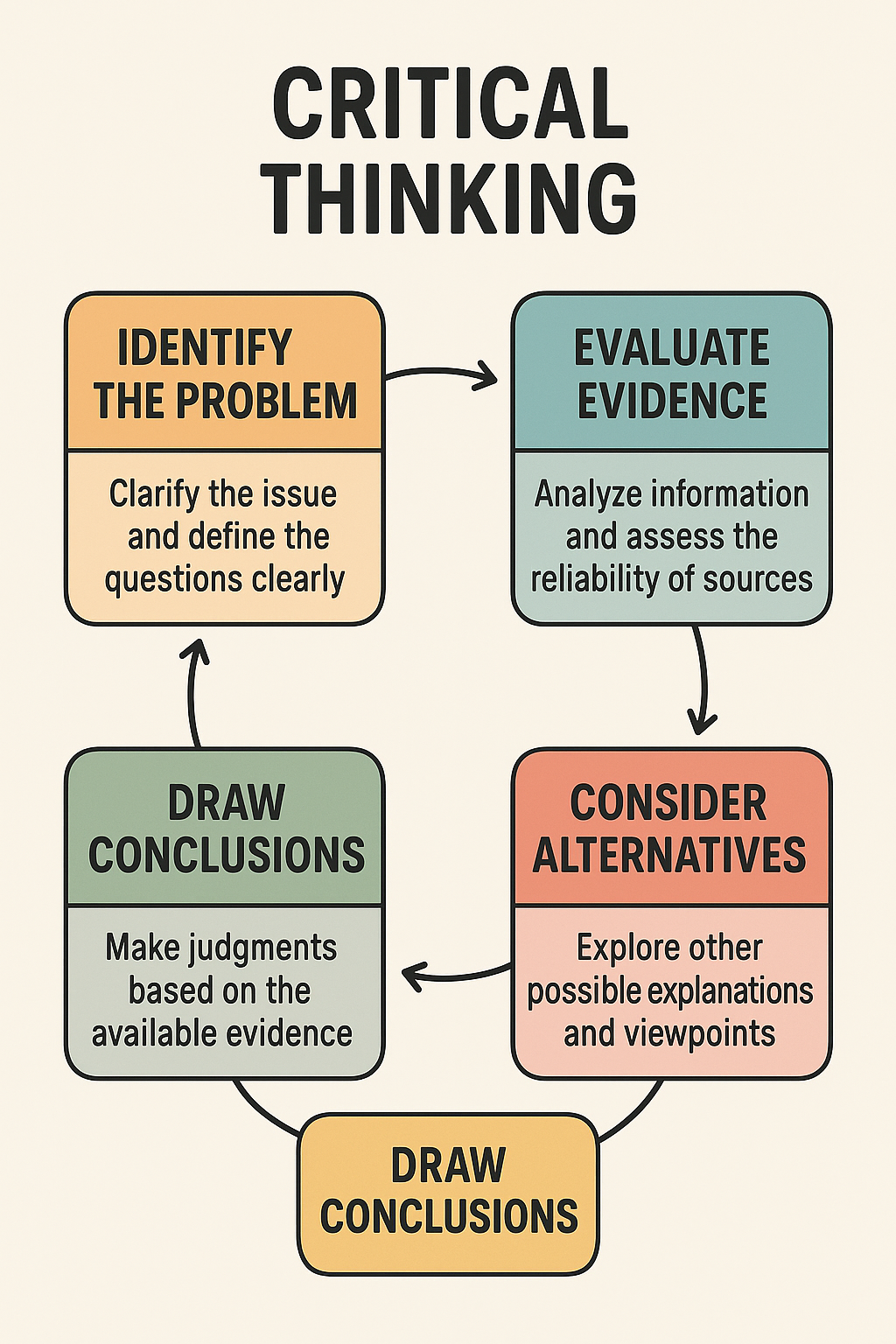
Basic Steps of Critical Thinking
- Identify the problem: Clearly define the problem you want to solve or the argument you want to evaluate
- Gather information: Find relevant facts, data, and perspectives
- Evaluate evidence: Check the reliability and relevance of the evidence
- Consider alternative explanations: Think about other possible explanations or viewpoints
- Form a conclusion: Draw a conclusion based on evidence and reasoning
Attitudes for Critical Thinking
- Openness: Willingness to consider different perspectives and possibilities
- Curiosity: Maintaining curiosity about the nature and causes of things
- Skepticism: Not easily accepting unverified claims
- Humility: Acknowledging the limitations of one's knowledge and understanding
- Systematicity: Thinking about problems in an organized way
Course Summary
Today we learned:
- The structure and types of arguments, including premises, inference process, and conclusion
- The distinction between valid and invalid arguments and the idea of soundness
- Characteristics and differences between deductive and inductive reasoning
- Common logical fallacies such as ad hominem, appeal to authority, straw man, slippery slope, and appeal to emotion
- The basic steps and attitudes of critical thinking
These skills will help you analyze and evaluate arguments, avoid common fallacies, and develop critical thinking.