Day 4: Deductive Reasoning and Logical Rules
Learn the basic structure of syllogisms, how to use logical symbols, and the fundamental rules of inference.
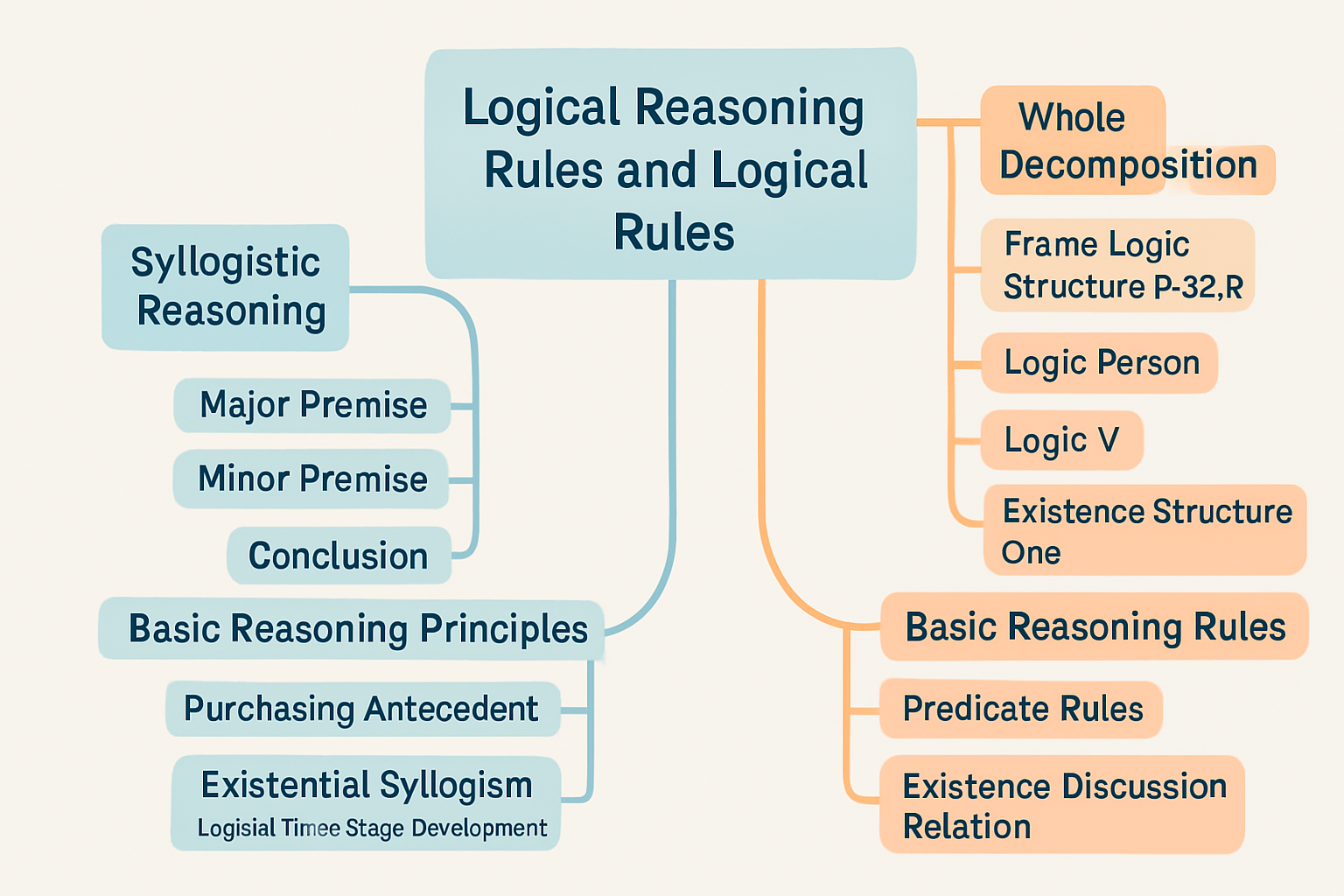
Mind map of deductive reasoning and logical rules
Course Objectives
This lesson introduces the structure and rules of deductive reasoning. Students learn the form of syllogisms, how to use basic logical symbols, and how to apply inference rules.
After completing this lesson, students will be able to:
- Understand the features and uses of deductive reasoning
- Analyze the structure and validity of syllogisms
- Use basic logical symbols to express propositions and arguments
- Apply inference rules for valid reasoning
- Use Venn diagrams to test syllogisms
Deductive Reasoning Basics
Deductive reasoning moves from general principles to specific cases. If the premises are true, the conclusion must also be true.
Characteristics
- From general to specific
- Necessity: true premises guarantee a true conclusion
- High certainty
- No new information: the conclusion is already contained in the premises
Example
All mammals have hearts. (General principle)
All dogs are mammals. (General principle)
Therefore, all dogs have hearts. (Specific case)
This example shows that if the premises are true, the conclusion necessarily follows.
Syllogisms
A syllogism is a basic form of deductive reasoning consisting of two premises and a conclusion. It involves three terms: the major term, the minor term, and the middle term.
Structure
- Major premise: contains the major term and the middle term
- Minor premise: contains the minor term and the middle term
- Conclusion: contains the minor term and the major term
Where:
- Major term: predicate of the conclusion
- Middle term: appears in both premises but not in the conclusion
- Minor term: subject of the conclusion
Example
All humans are mortal. (Major premise)
Socrates is human. (Minor premise)
Therefore, Socrates is mortal. (Conclusion)
In this example:
- The major term is "mortal"
- The middle term is "human"
- The minor term is "Socrates"
Validity of Syllogisms
The validity of a syllogism depends on its form rather than its content. A valid form guarantees that if the premises are true, the conclusion must be true.
Some basic rules for syllogistic validity are:
- The middle term must be distributed in at least one premise
- If a term is distributed in the conclusion, it must be distributed in the corresponding premise
- At least one premise must be affirmative
- If one premise is negative, the conclusion must be negative
- Two negative premises cannot yield a valid conclusion
Basic Logical Symbols
Logical symbols represent relations and operations in logic. They make logical expressions concise and precise.
Propositional Symbols
Yesterday we learned these basic symbols:
- ∧: conjunction (and)
- ∨: disjunction (or)
- ¬: negation (not)
- →: conditional (if...then)
- ↔: biconditional (if and only if)
Predicate Symbols
Predicate logic also uses:
- ∀: universal quantifier, "for all"
- ∃: existential quantifier, "there exists"
- P(x): predicate meaning "x has property P"
Expressing Propositions
For example, "All humans are mortal" can be written as:
∀x(H(x) → M(x))
Here H(x) means "x is human" and M(x) means "x is mortal".
"Some students like math" can be written as:
∃x(S(x) ∧ L(x,m))
where S(x) means "x is a student" and L(x,m) means "x likes math".
Basic Rules of Inference
Rules of inference allow us to derive conclusions from known premises. Some basic rules are:
Modus Ponens
If p → q is true and p is true, then q is true.
If it rains, the ground gets wet. (p → q)
It rains. (p)
Therefore, the ground is wet. (q)
Modus Tollens
If p → q is true and q is false, then p is false.
If it rains, the ground gets wet. (p → q)
The ground is not wet. (¬q)
Therefore, it didn't rain. (¬p)
Hypothetical Syllogism
If p → q and q → r are true, then p → r is true.
If it rains, the ground gets wet. (p → q)
If the ground is wet, shoes get dirty. (q → r)
Therefore, if it rains, shoes get dirty. (p → r)
Disjunctive Syllogism
If p ∨ q is true and ¬p is true, then q is true.
Either it rains or it snows. (p ∨ q)
It does not rain. (¬p)
Therefore, it snows. (q)
Addition
If p is true, then p ∨ q is true (for any q).
It rains. (p)
Therefore, either it rains or it snows. (p ∨ q)
Simplification
If p ∧ q is true, then p is true and q is true.
It is raining and windy. (p ∧ q)
Therefore, it is raining. (p)
Therefore, it is windy. (q)
Conjunction
If p is true and q is true, then p ∧ q is true.
It rains. (p)
It is windy. (q)
Therefore, it is raining and windy. (p ∧ q)
Validity Proof
A validity proof shows that an argument is logically sound. Here is a simple example:
Example
Prove the following argument is valid:
1. If it rains, the ground is wet. (p → q)
2. If the ground is wet, shoes get dirty. (q → r)
3. It rains. (p)
4. Therefore, shoes get dirty. (r)
Proof
- p → q (premise 1)
- q → r (premise 2)
- p (premise 3)
- q (from 1 and 3, modus ponens)
- r (from 2 and 4, modus ponens)
Therefore, the conclusion r is valid.
Venn Diagrams
Venn diagrams use circles to represent sets. They help us analyze the validity of syllogisms.
Basic Form
The overlapping parts of circles show the intersections of sets.
Using Venn Diagrams
For example, consider this syllogism:
All humans are mortal. (Major premise)
Socrates is human. (Minor premise)
Therefore, Socrates is mortal. (Conclusion)
In the diagram:
- One circle represents people
- Another circle represents mortal things
- Socrates is marked as a point
The major premise places the circle for people entirely inside the circle for mortal things.
The minor premise locates Socrates inside the circle of people.
Therefore, the diagram shows Socrates is also inside the circle of mortal things.
Course Summary
Today we learned:
- The features and uses of deductive reasoning
- The structure and validity of syllogisms
- The use of basic logical symbols
- Common inference rules such as modus ponens, modus tollens, and hypothetical syllogism
- How to conduct a simple validity proof
- How to use Venn diagrams to test syllogisms
These skills will help you better understand deductive reasoning and strengthen logical thinking.