Day 3: Logical Connectives and Compound Statements
Learn how logical connectives combine simple statements into compound statements and how conditionals and biconditionals work.
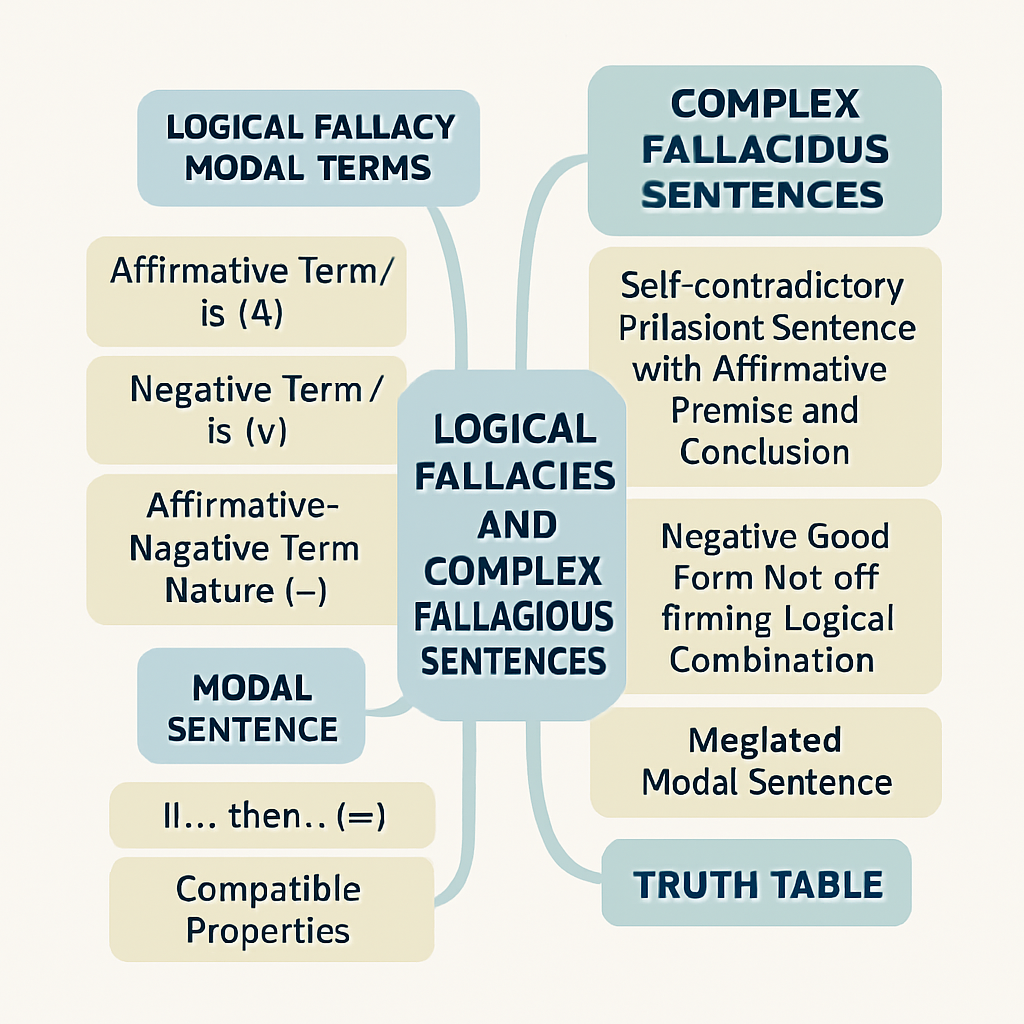
Mind map of logical connectives
Course Objectives
This lesson introduces the five basic logical connectives and shows how to analyze the truth of compound statements.
After completing this lesson, students will be able to:
- Understand conjunction, disjunction, negation, conditionals, and biconditionals
- Build compound statements using these connectives
- Analyze conditionals and biconditionals
- Use truth tables to evaluate compound statements
Logical Connectives Basics
Logical connectives link simple statements to form more complex ones. The main connectives are AND (∧), OR (∨), NOT (¬), IF-THEN (→), and IF AND ONLY IF (↔).
Conjunction (AND)
The conjunction p ∧ q is true only when both p and q are true.
Disjunction (OR)
The disjunction p ∨ q is true when at least one of p or q is true.
Negation (NOT)
The negation ¬p is true when p is false and false when p is true.
Conditional Statements
The conditional p → q is false only when p is true and q is false.
Biconditional Statements
The biconditional p ↔ q is true when p and q have the same truth value.
Truth Tables
Truth tables list all possible truth values for compound statements. They are useful for checking validity.
Course Summary
Today we learned:
- The meanings of the five logical connectives
- How to form compound statements
- How to evaluate conditionals and biconditionals
- How truth tables help analyze logical relationships
These ideas lay the groundwork for understanding deductive reasoning.